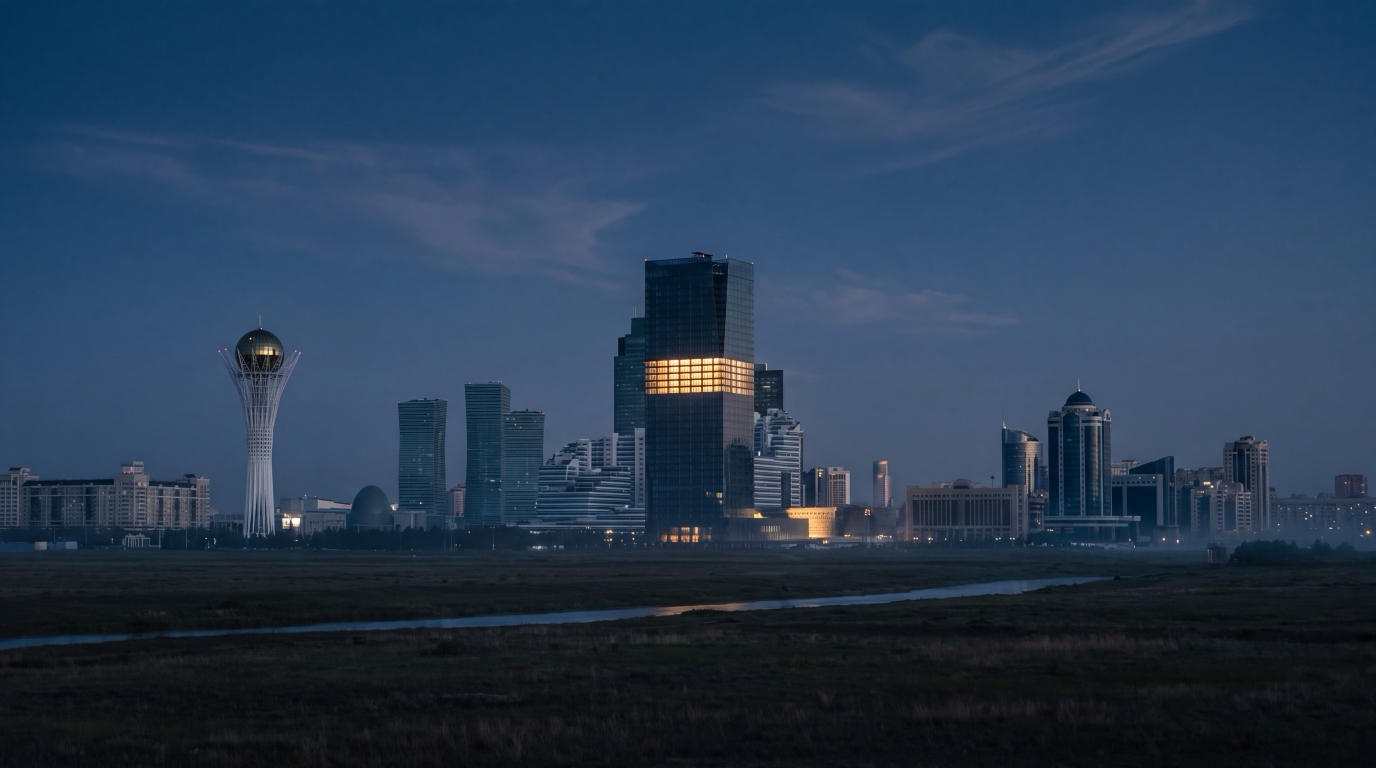
Network School Kazakhstan: A Network State With a Landlord
An update from the Network State Conference 2026 and from Network School Kazakhstan, where our founder is this week. The network found land. It is rented.
Our founder, David Stancel, has spent this week in Astana, working from Network School's floor at Alem.ai, the Kazakh state's artificial intelligence centre. On 9 October, while he was there, the Network State Conference filled level 5 of the Marina Bay Sands convention centre in Singapore. A good part of that day was about the building he was sitting in.
So this is an update from both ends: what the Network State Conference 2026 put on record, and what Network School Kazakhstan looks like from the inside, six weeks after it opened.
The short version. Balaji Srinivasan's rule for building a new society was always "cloud first, land last". In 2026 the land arrived. It was not bought, and it was not won. It was offered by a state, on that state's paper.
Two camps are already arguing about what this means. The enthusiasts say the network has found its state. The sceptics say it is a special economic zone with a community manager. Both are swinging a machete. The useful question is smaller and more practical: which legal instrument does each party stand on? The zone, the network and the individual member hold three very different things.
The fullest written account of the conference is Parallel Citizen's recap, and it is what sent us back to the sources. We kept only what we could match to a primary source.
The update from the Network State Conference 2026
Three names on the official programme were not founders or investors. They were officials of one state: Zhaslan Madiyev, Deputy Prime Minister of Kazakhstan, the country's Minister of Science and Higher Education, and the deputy chief executive of the Alatau City Authority, which the organisers bill as "Kazakhstan's first crypto city". A host government had its own block of the agenda.
Four more things came out of Singapore.
- A state signed. The memorandum behind those officials is with Kazakhstan's Ministry of Artificial Intelligence and Digital Development and runs for five years. The Prime Minister's office describes the project as "implemented through private funds, without attracting state financing".
- The deal was shopped. Srinivasan told Unchained that more than ten countries bid for Network School and that he sees Kazakhstan as "Singapore with space to build". He likened winning over a government to enterprise sales, noting that half the world's countries have under ten million people. That is his account. No government has confirmed a bid.
- Capital followed, and the valuation is confirmed. Polychain founder Olaf Carlson-Wee announced from the conference stage that his firm is leading a new round that values Network School at $2 billion. Andreessen Horowitz (a16z) and Coinbase are taking part, alongside Srinivasan himself, TechFlow reports. The amount raised was not disclosed.
- The school becomes a university. For members this may be the announcement that matters most. Srinivasan said on stage that Network School has signed a memorandum with Kazakhstan's education ministry to become a degree-granting university, as Parallel Citizen recorded it. Students graduate by passing exams and not by years attended, residential cohorts meet for about a week each quarter, diplomas are issued on-chain, and Kazakhtelecom, the national telecom operator, has agreed to place graduates in jobs. Sayasat Nurbek, the Minister of Science and Higher Education, was on the conference programme. The memorandum itself has not been published yet.
The same programme carried a Zcash summit on financial privacy and a ministerial pitch for partnership with a state. Parallel Citizen pointed out that no speaker addressed the tension between the two. We come back to it below.
The update from Network School in Astana
The story from the stage was that the network chose Kazakhstan. Here is the same story with dates.
On 21 July the Iskandar Puteri City Council in Johor, Malaysia, revoked the business licence of the company that ran Network School in Forest City and ordered it to stop operating. One day later Srinivasan announced the memorandum with Kazakhstan. On 2 September the school opened at Alem.ai.
Six weeks from revocation to ribbon-cutting. A community of remote earners changed countries faster than most companies change offices.
It could move that fast because nothing a member needs is bolted to the ground. Income arrives over the internet. The curriculum is a calendar. And the receiving state had already digitised itself: around 90% of Kazakhstan's 1,300-plus public services are online, and the country ranks 24th in the UN's e-government index, per The Times of Central Asia.
Astana is the first stop and not the last. The Prime Minister's office says the two sides considered an innovation hub in the Akmola Region, which surrounds the capital, "with further expansion to Alatau City", the new zone north of Almaty. A concept for a "Network City" in the village of Burabay was presented at the same meeting. Those are plans. What exists today is a floor in a government building, and a memorandum.
Cloud first, land last. The land is rented.
In Srinivasan's own sequence, a startup society grows into a network union, then a network archipelago, and becomes a network state only at the last step: diplomatic recognition from an existing state. Kazakhstan gave Network School something earlier and different. Not recognition. A host.
That matters because every node sits on a legal instrument, and instruments have ranks. Think of it as a ladder.
- Rung one: a municipal licence. Forest City. Fortune reports that the council cited breached licensing conditions and premises-use requirements, after a separate probe into the school had found no travel-document violations. One special council meeting ended a presence that began as a 90-day pilot in 2024.
- Rung two: a memorandum. Astana. A memorandum records intent. It commits no budget and creates no right that a member could enforce. The Prime Minister instructed state bodies to assist, which is worth a great deal in practice and very little in a courtroom. The university deal, as announced, is a second memorandum on the same rung.
- Rung three: a constitutional law. Alatau City, an 88,000-hectare zone. In May 2026 Kazakhstan gave it a special regime by constitutional law. According to Morgan Lewis, that law prevails over ordinary legislation including the Tax Code, lets city regulation draw on English and Welsh legal principles, sends investment disputes to the court of the Astana International Financial Centre, and gives qualifying projects a ten-year tax stability guarantee.
Kazakhstan has run this play before. The AIFC court has applied common law in Astana since 2018, and the centre has more than 5,400 registered companies. This is a state that knows how to build a legal island and keep it.
Now look at who stands where. The zone is anchored in constitutional law. The network is there by memorandum. The member is there on a one-year visa.
Standing does not flow downhill by itself.
The Steelyard problem
Networks renting standing from sovereigns is an old arrangement. The Hanseatic League, the most successful merchant network of medieval Europe, kept a walled German enclave on the north bank of the Thames called the Steelyard, with trading privileges that English kings granted and renewed over some three centuries. English merchants lobbied against those privileges for generations. In 1598 Elizabeth I closed it, revoked the privileges and told the remaining merchants to leave.
The Hansa did not lose a war over the Steelyard. It lost a licence.
What it kept was the thing that had made it powerful all along: its merchants could be trading in Bruges or Bergen the same season. That is the asset Network School demonstrated in July. Exit, performed by a whole community at once.
Jurisdictions as vendors, communities as buyers
What is new in 2026 is that both sides treat this as procurement.
Ârc spent eighteen months inside Network School in Forest City, says it helped 1,000 founders there, and now runs from Mirissa Beach in Sri Lanka. Its page for governments says it is "running a competitive process to choose where we build next" and lists what it wants: autonomy over law and regulation, common-law frameworks inside the zone, international standing, a partnership measured in decades. That is a request for proposals. Written by a community, addressed to states.
The states answer in kind. Presenting the Alatau law in May, Deputy Prime Minister Kanat Bozumbayev called it a charter city and volunteered the base rate: more than 1,000 special zones created worldwide in the past decade, roughly 60% of which missed their goals. A zone without tenants is a failed zone. A network that arrives with its own residents, events and investors is the anchor tenant every zone operator wants, and anchor tenants get terms nobody else gets.
The pop-up circuit has become the showroom for these deals. Edge City counts 12,500+ participants across its villages, is building a permanent one in California with up to 605 residences, and is running its India edition in Goa this month. Ârc states the method outright: "pop-up first, then permanent". In June we argued that pop-up cities had solved community and not continuity, and that continuity is a jurisdiction problem. Four months later the sector has given its answer. Rent the jurisdiction.
Who gains, and who carries the risk
- The host state gets talent, attention and a live demonstration for its zone, at no budget cost by its own account.
- The network operator gets a home, a ministerial counterparty, a path to university status and a $2 billion valuation. At that price, investors are paying for the one asset that proved portable in July, which is the community and not the address.
- The member gets cheap entry to a working scene, and carries a concentration risk nobody prices. Visa support, housing, the room you work in and the people you came for all hang from a memorandum you are not a party to.
That last point is not a complaint about Network School. David is a member, and he would rather be on that floor than reading about it. It is a description of where the paper sits.
The strongest objections
"This is a special economic zone with a community manager." Partly. UNCTAD counted nearly 5,400 zones worldwide in 2019, and none of them made anyone sovereign. But zones recruit firms one at a time. The new thing is a tenant that arrives already assembled, selects its own members and can credibly leave together. That changes the bargaining. It does not change the sovereignty, and on that point the purists are right: none changed hands in Astana.
"Kazakhstan will do to network people what it did to Bitcoin miners." This is the objection to take seriously, because the precedent is close. After China's 2021 mining ban, Kazakhstan's share of global Bitcoin hashrate went from 8% in April to 18% in August, according to Cambridge data reported by Reuters. By late January 2022 miners had been cut off from the grid for the rest of the month. That same January, during unrest, the internet went down nationwide for days, and NetBlocks measured connectivity at 5% of ordinary levels. Freedom House scores the country 23 out of 100, Not Free, in 2026.
Two things separate the cases. Miners consumed a scarce, subsidised resource and competed with households for it. A few floors of remote earners consume apartments and restaurant tables. And the AIFC kept its rules through the same years in which the miners lost theirs. A state protects what it showcases.
Still, nobody can hedge an internet shutdown from inside the country. That is the answer to the tension nobody addressed on stage: private money and a second residency are what you carry in case the host changes its mind. The risk is real, it differs in kind from the miners' risk, and the only way to price it is to keep your exit cheap.
"Members can always leave." Yes. That is the whole asset. So the things that make leaving cheap are the things to own.
What a Network School Kazakhstan member can hold
For mobile individuals:
- A visa that is yours. Kazakhstan's Neo Nomad Visa (B12-1) asks for proof of at least $3,000 a month in income over six months and can be extended for up to one more year. It is issued to you and not to your community. Network School tells incoming members to allow about three weeks for a one-year digital nomad visa.
- A tax position you chose. Spend 183 days in Kazakhstan in any rolling twelve months and you are tax resident, taxed on worldwide income at 10%, and 15% above a high threshold, as of 2026. A fully used one-year visa crosses that line. Cross it on purpose, and remember that the day count is only where the analysis starts.
- No illusions about e-Residency. Kazakhstan launched an e-Residency on 1 January 2026. It opens services inside the AIFC, and its identification number is not the same thing as a state IIN. It is a login. It gives no right to live anywhere.
- A diploma, once it exists. An exam-based degree with an on-chain record would be the first thing in this deal issued to the member and not to the network. The record cannot be taken back. The right to grant degrees can, because it comes from the host's education ministry. Before you plan around the degree, ask which instrument that right rests on.
- A watch on Alatau. The constitutional law creates a "resident of Alatau" status that can be granted to individuals as well as companies. As of mid-October 2026 we could not find published categories for individuals, and existing zone participants re-register between 1 January and 1 July 2027. If individual status opens, it will be the first rung of this ladder a member can hold personally.
- One residency that depends on no community at all. Flag theory was built for this. A node is a place to live for a season. It should never be the only place you are allowed to be.
For founders: keep the company out of the node's paperwork. Incorporate where your contracts get enforced and your bank is comfortable, then decide where you sit.
For operators and hosts: the role we called the standing owner in June now has a job description. Find out which instrument the deal rests on, push it up the ladder, and negotiate status for the members and not only for the organisation. Ârc's list for governments has four demands. None of them is that residents hold their status directly.
The open edge
Our directory tracks more than 100 pop-up cities and startup societies, and Network School's own dashboard lists 38. In 2026 the best known of them showed that a society can change countries in six weeks and that a state will sign for it. What nobody announced in Singapore is a deal in which the members, and not the network, hold the paper.
Three signals are worth watching. Whether Alatau publishes resident categories an individual can apply for. Whether a second node signs with one of the "more than ten" bidders, and on which rung. And the first real dispute between a node and its host, because that is when a memorandum gets read by people who did not write it.
The Hansa lasted three centuries on borrowed standing. It ended with one royal order.
David is in Kazakhstan until the end of October, in Astana and then Almaty. We will report back if any of the three signals moves.
This analysis is general information, not legal or tax advice. Visa, residency and tax outcomes are fact-sensitive and the rules described here are changing. Consult a qualified advisor before making residency decisions.
Polystate works on the layer underneath mobile communities: residency, entities and banking held in your own name. Run the Polystate diagnostic to compare options, or explore our services.