Praxis in Uruguay: A Free City Without a Free Zone
Praxis asked for a country and settled for a neighbourhood in Uruguay. No zone, no charter. Why that may be the safer bet, and what Uruguayan law gives you.
Praxis spent seven years asking governments for a country. Last month it settled for a neighbourhood.
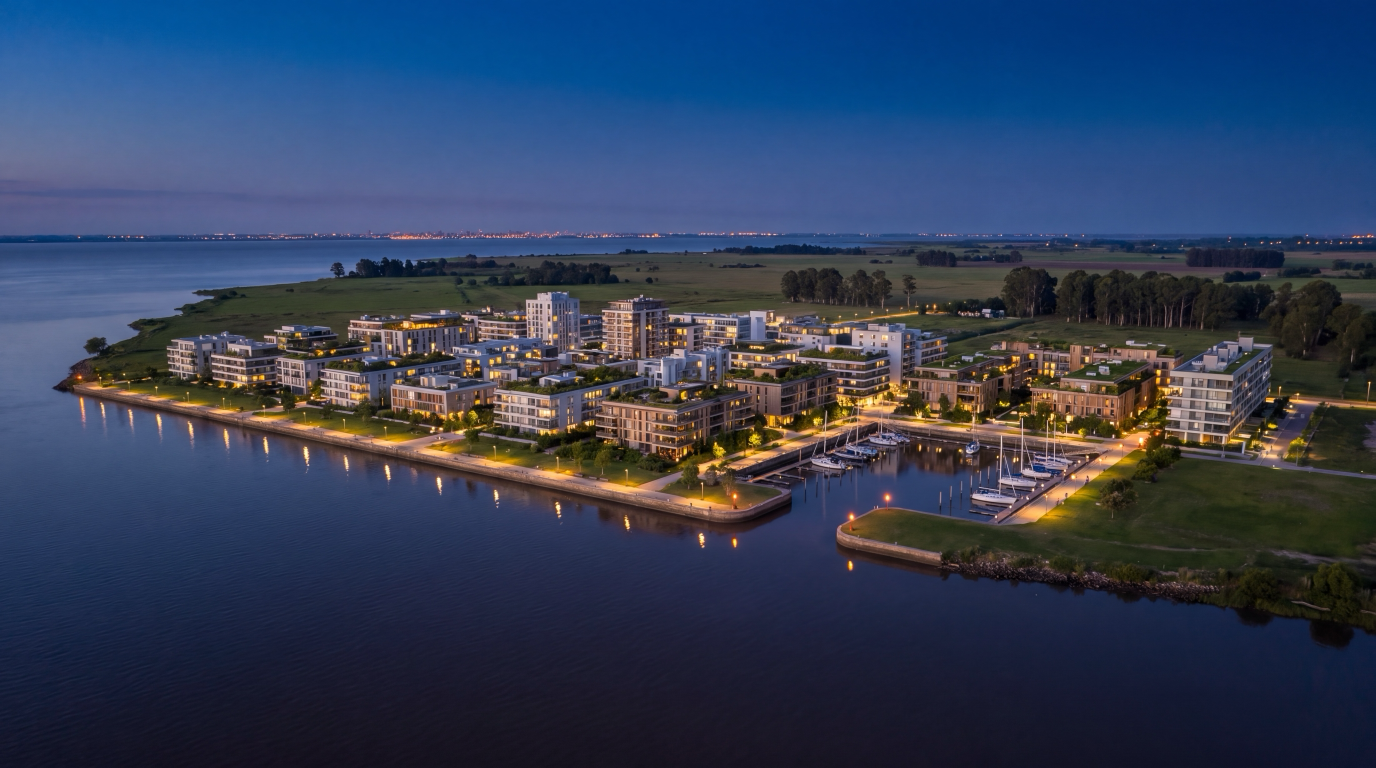
On 22 September 2026, the best-known network state brand in the world announced where it will finally build: about 350,000 square metres of buildable area inside +Colonia, a 515-hectare waterfront development beside Colonia del Sacramento, roughly an hour by ferry from Buenos Aires. Somebody else's project. Under somebody else's law.
No special zone. No charter. No legal order of its own. Praxis's Uruguay page gives the whole subject one sentence: "A stable democracy with strong institutions and the rule of law." The developer, Eduardo Bastitta, told Perfil he rules out a separate legal order and compares the place to Nordelta, the private town outside Buenos Aires.
Within a week the reactions had sorted themselves into two camps. The sceptics, Gil Duran loudest among them, call it vapour: a manifesto bolted onto another man's apartment towers. The believers call it a tactical retreat on the way to the real thing. While I understand both, I think both are measuring the wrong variable. They ask how much sovereignty Praxis was granted. The better question about Praxis Uruguay is how much of the project the host can take back, and what taking it back would cost.
I call that the revocation surface.
It is also my obligation to say where I stand. I live under plain national law as a resident of Paraguay, I spent time in Próspera in early 2025, and Polystate helps people set up residencies and companies for a living. I am not neutral on whether ordinary law is underrated. Judge the argument accordingly.
Seven years of asking permission
Praxis began around 2019 as Bluebook Cities, founded by Dryden Brown and Charlie Callinan. The places it tried since read like an atlas. A stretch of the Adriatic in 2023, for a city of about 10,000, per The Fence. Greenland in 2024, where Danish MP Rasmus Jarlov replied in public that there was "no way" parliament would approve it, as TechCrunch reported. A proposed spaceport city on Vandenberg Space Force Base in 2025. Then a scouting tour of nine cities, from Nuuk to Tokyo.
Every one of those was a request. None was a purchase.
The money needs more care than the map, because three numbers circulate and they are not the same kind of number.
- About $20 million is equity. A seed of about $4 million in 2021, then a $15 million Series A in March 2022 with Paradigm, Alameda Research, Three Arrows Capital, Apollo Projects and Robot Ventures.
- The famous $525 million is a facility. TechCrunch's wording: Praxis "has the ability to draw down the money as it hits specific milestones in its city-building project." I found no report of a draw.
- The $1 billion for Uruguay is a projection. Forbes Argentina calls it projected investment over the first years. Most of it is what members would spend building their own homes.
The community figures need the same split. Praxis claims more than 150,000 members. Bastitta's number for "praxianos" who formally expressed interest in moving is 2,700.
Two more facts keep this honest. The agreement with +Colonia has been reported as largely non-binding. And the land is not bought. Bastitta again: "La compra todavía no está efectiva porque falta fraccionarla." The purchase is not effective because the land still has to be subdivided. Forbes Argentina puts the first acquisition in the first half of 2027. Il Post says the end of that year.
Praxis also arrives with baggage. In 2023 Mother Jones published allegations from anonymous former employees about Brown's political views and the company's internal culture. Praxis answered that it "exists to build" and would not let gossip stop it. I was not in those rooms and I will not pretend to know. It matters here for one reason: a project with that file is a hard thing for any parliament to hand a charter to.
The revocation surface
The Free Cities Foundation sorts free city strategies into two roads. Top-down: negotiate a special legal status, then build on it. Bottom-up: settle under existing law as an intentional community, and talk to the government once you are worth talking to. It classes Praxis's move as a switch from the first road to the second. That classification is theirs, and I think it is right.
What it leaves open is why the second road might be safer and not merely easier. Here is my answer. Every project of this kind rests on something the host state can withdraw. The three live cases in 2026 rest on three different things.
- A statute. Próspera built on Honduras's ZEDE law. Congress repealed that law in 2022, and the Supreme Court declared the regime unconstitutional in September 2024. Próspera reports 1,700+ residents, $100M+ invested and 200+ businesses, and it is still operating. Its legal footing is now an investment-treaty claim, ICSID case ARB/23/2, registered in February 2023 and still pending. One vote removed the foundation.
- A licence. Network School ran in Forest City, Malaysia, under ordinary law and a business licence. In July 2026 the authorities revoked the licence and ordered it to stop operating from 22 July, The Block reported. Inspections had found 266 foreign members with valid travel documents. No legislature was needed. One signature.
- Title and status. The Free State Project asked New Hampshire for nothing. About 6,232 participants had moved by May 2022, per Wikipedia's count. They are owners, residents and voters like anyone else. There is nothing to repeal.
Praxis in Uruguay belongs in the third group. Its members would hold freehold property and individual residency. To undo that, a state has to act against thousands of owners and residents, one at a time, against ordinary constitutional property protection. That is expensive in a way that repealing a statute is not.
Why does the first road keep breaking at the same point? It's a knowledge problem. A charter granted up front asks a parliament to price a community that does not exist yet. Who will come, what they will build, whether they will be good neighbours: the government does not know, and neither do the founders. So the deal gets made on a pitch deck, and unmade the first time an election changes who is reading it. Settling under ordinary law is how both sides find out. Cheaply.
History points the same way. Medieval European towns usually got their charters after they had the trade, and often paid a lord for the privilege. The modern special economic zone, from Shannon in 1959 to Shenzhen in 1980, was a state's own project for the state's own reasons. A private group asking for a zone before it has a single resident is the historical oddity. And the fragile one.
The trade is plain. A statute gives you your own tax code and your own courts on day one, with a single point of failure. Title gives you nothing special. Nothing that can be cancelled in an afternoon, either.
What ordinary Uruguayan law gives a mover
This is the part the Praxis coverage skips. It is also where the decision gets made if you are one person and not a movement.
Start with stability. Freedom House scores Uruguay 97 out of 100 for 2026.
Then tax, where the ground moved this year. The 2025–2029 budget law, Ley 20.446, rewrote the regime for new tax residents from 1 January 2026. According to a Vialto Partners alert on the law:
- The holiday still exists. New tax residents can keep non-resident treatment on foreign capital income for the year they move plus the following ten.
- Presence qualifies on its own. More than 183 days in Uruguay in each calendar year, with no investment required.
- The investment route got expensive. Real estate above UI 12,500,000, about $2 million, or at least UI 625,000 a year, about $100,000, into qualifying funds.
- The old regime is closed. It could only be elected until 31 December 2025.
- Outside the holiday, territoriality narrowed. A general 12% rate now reaches gains on assets held abroad, not only foreign dividends and interest.
Read those five lines together. Uruguay repriced the shortcut and left the presence route free. It is selecting for people who show up. A community whose whole pitch is physical co-presence qualifies by doing what it says it wants to do. A flag-planter does not. If you are sizing this up for yourself, read how the 183-day rule works in practice and why territorial systems still tax you first.
Citizenship is on the table too. The Corte Electoral cites Article 75 of the Constitution: three years of habitual residence with a family established in Uruguay, five without.
And the free zones, since "why not just get a zone?" is the obvious question. Uruguay has 14 authorised free-zone facilities, 12 operating, which carried 32% of goods exports in 2022, per Uruguay XXI. They are a tax and customs regime for companies. They are not self-government. I found no source showing +Colonia holds a free zone, an investment-promotion declaration or any other special regime. What it has is a planning contract approved by Colonia's departmental board in 2022, as La Nación reported.
Three objections I take seriously
It is a condo project with a manifesto. This is the strongest one, and most of it is true. +Colonia has about 800 units under construction or about to start. Asked whether 1,500 people already live there, Bastitta said no. The roughly $300 million of investment is his own figure and, per Perfil, about $30 million of it is the developer's. Praxis has bought nothing. But the test is cheap and it has dates: a land purchase in 2027, residents by mid-2027. And look at the failure case. If the brand dissolves, members own flats in a functioning country. On the statute road, the failure case is arbitration.
Density buys nothing. Two decades of the Free State Project produced influence inside New Hampshire's existing institutions. Not a special status. That is a fair reading of the best data point we have. Colonia del Sacramento has about 30,000 inhabitants, so 2,700 arrivals would be a visible bloc, but 2,700 is expressed interest, and voting waits on citizenship three to five years out. Bottom-up buys a seat at the table. It does not buy the table.
The political risk has only moved. Correct. The Frente Amplio councillors in Colonia have asked for a meeting with President Orsi about the project. They belong to his own party, and their bloc voted against +Colonia in 2022. The revocation surface is small for what already exists and wide for what does not: every later phase needs fresh departmental approvals. The host cannot easily take back. It can stop giving.
What I would do with this
If you are a founder, sequence matters more than ambition. Acquire the things that cannot be revoked first: title, residents, a payroll. Ask for a statute when your leaving would hurt the host. Not before.
If you are an investor, price a free city by its revocation surface, and by what is titled against what is announced. A $525 million facility next to $20 million of equity tells you which number to underwrite.
And if you are simply a person deciding where to live, remember that your position is yours and not the brand's. Residency, tax status and a deed survive whatever happens to Praxis. The same logic sits under the continuity problem in pop-up cities: the community is the easy part now. The legal foothold was always the hard part.
The open question
Suppose it works. Two thousand people move, the neighbourhood fills, Colonia grows for the first time in decades. What does Praxis then ask Uruguay for?
As far as I can find, Uruguayan law has no instrument for it. The free-zone statute covers companies inside a perimeter. Investment promotion covers projects. Nothing on the books grants a residential community its own rules. The EU is discovering a version of this with its 28th regime: the legal product people want does not exist until somebody drafts it.
On the bottom-up road, that drafting job falls to the community. Praxis spent seven years asking for a status. It may now have to write one.
Following a network state project, or weighing Uruguay against other bases? Run the Polystate diagnostic to compare options, or explore our services.