
Best Digital Nomad Visas 2027: What You're Really Buying
The best digital nomad visas for 2027 with real income bars, and the question most lists skip: does the time count toward anything?
The short answer: the best digital nomad visas for 2027 are Spain and Portugal for a European base, Thailand's DTV for flexibility, and Colombia, Uruguay or Brazil for the lowest bar to entry. The full list, with every figure checked against official sources, is further down.
First, a number. Colombia's income bar for remote workers rose 23% this year, and nobody touched the visa rules. The bar is three times the national minimum salary. In 2026 the minimum salary went up 23%. The visa got more expensive by decree, from a ministry that was not thinking about nomads at all.
That is the real story going into 2027. Nomad visas stopped being a pandemic experiment and became a product. Jurisdictions now run them the way software companies run subscription tiers: a price indexed to something you do not control, discounts by age and region, a family surcharge, and terms that change every January.
And the product is narrower than the marketing. A nomad visa sells the right to be somewhere. It rarely sells the right to stay. It almost never sells the right to belong.
You are renting. Price it like rent.
A product invented in the summer of 2020
In the summer of 2020, Estonia and Barbados created a new kind of permission. Barbados opened applications for a 12-month Welcome Stamp in July 2020. Estonia launched its digital nomad visa the same summer. The pitch to their own voters was simple. A remote worker brings foreign income, spends it locally, takes no local job, and asks the state for nothing but a stamp.
Spending without voting.
It looked new. It is the reversal of a very old rule. Medieval German towns ran on the principle Stadtluft macht frei nach Jahr und Tag: city air makes you free after a year and a day. Live inside the walls long enough and presence turned into status. The clock was the whole point.
Modern nomad visas are engineered to stop that clock.
Presence, residence, membership
Every state sells three different things. For most of history it sold them as one bundle, and most people still assume it does:
- Presence: the right to be in the country and work for clients abroad. Every nomad visa sells this.
- Residence: a permit whose years count toward settling, usually permanent residence after five or more years.
- Membership: citizenship, and the passport that comes with it.
In Albert Hirschman's terms, a nomad visa gives you near-perfect exit and zero voice. You can leave tomorrow. You cannot vote, and in most cases you cannot stay long enough for that to change.
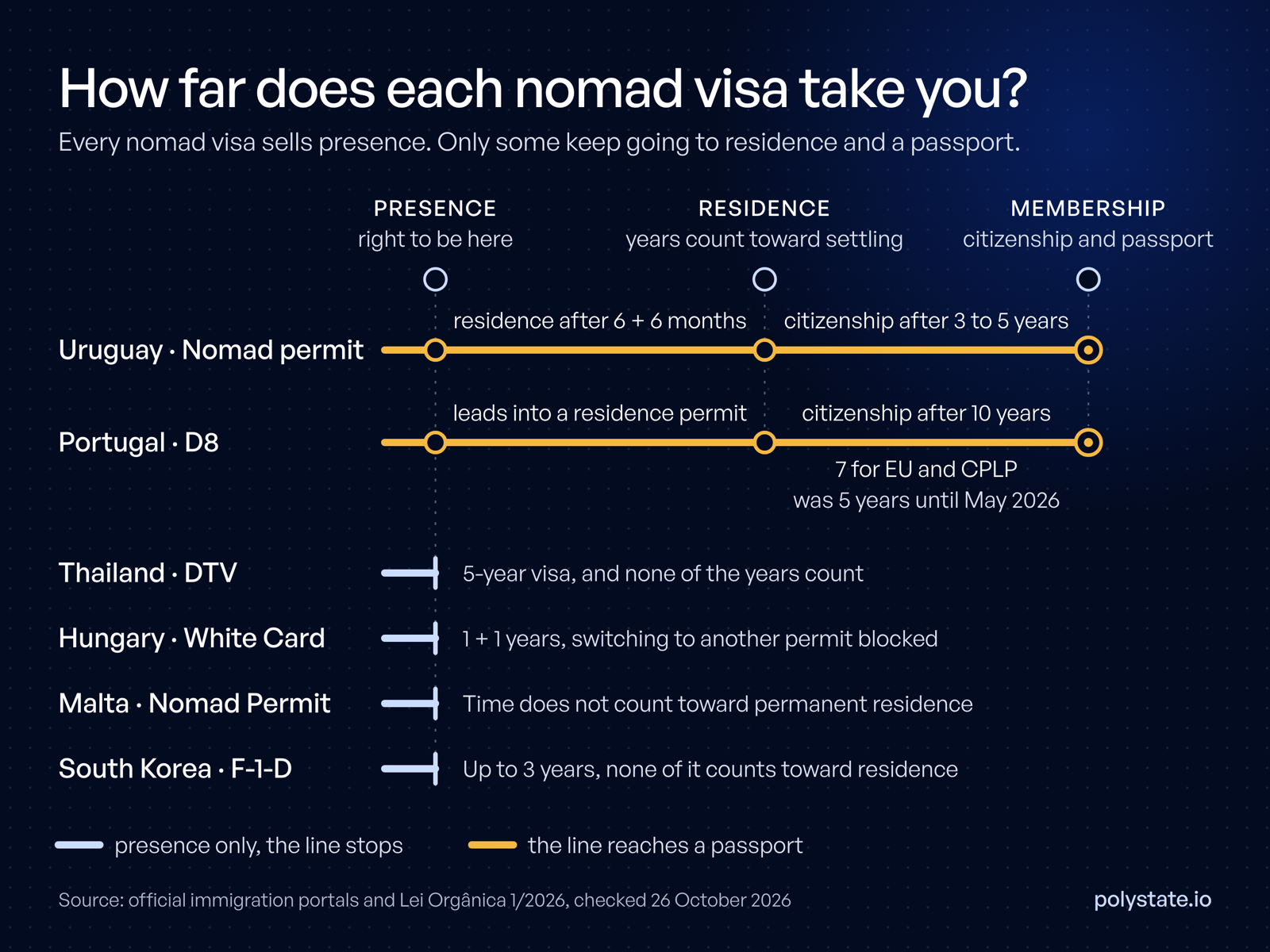
Read any nomad visa through these three layers and the brochure falls away. Some sell presence and quietly lock the other two doors:
- Hungary's White Card comes with no family visas and no national residence card, and you cannot switch to a permit for another purpose, during the card or after it.
- Malta's nomad permit does not count toward permanent residence.
- Thailand's DTV is valid for five years. None of those years count toward residence.
Others sit inside a real residence system but have watched the membership door get heavier. Portugal is the clearest case. Its D8 visa leads into residence, but Lei Orgânica 1/2026 moved citizenship from 5 years to 10 (7 for EU and Portuguese-speaking nationals). We called this the ratchet in June. Membership only gets more expensive.
Presence is cheap. Membership is being repriced upward. Residence is where the real decision sits.
None of this is hidden. It is just scattered across consular checklists in a dozen languages, and no ministry puts "this visa leads nowhere" on the landing page. A knowledge problem, in other words. The model above is the shortcut.
How states price presence in 2027
Three moves show up across the 2027 numbers.
Indexation. The income bar is pegged to local wages, so it moves when local wages move:
- Portugal asks four times the minimum wage: €3,680 a month in 2026, and a proposed €3,880 from January if the €970 minimum wage passes.
- Spain asks 200% of its minimum wage, about €2,849 a month under Royal Decree 126/2026.
- Croatia asks 2.5 times the average net salary: €3,622.50 a month.
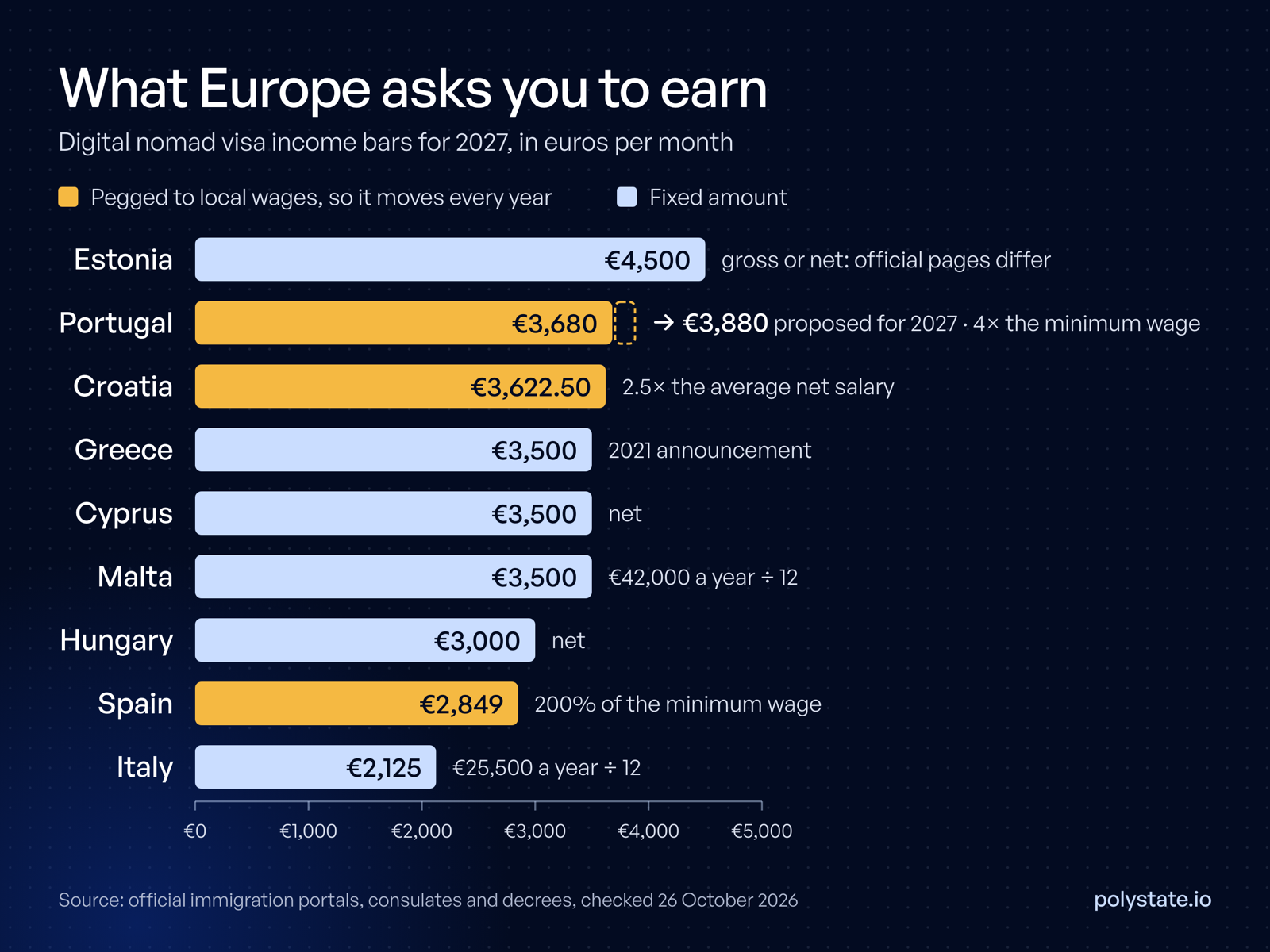
The bar tracks the host country's economy, not yours. The faster local wages grow, the faster the visa gets expensive.
Segmentation. South Korea now prices the same visa by age and location. Under 35 and living outside the Seoul area, you need one times Korea's income per head, KRW 52.4 million a year. Over 35 in Seoul, you need twice that. The cheaper tier is aimed at population-declining regions.
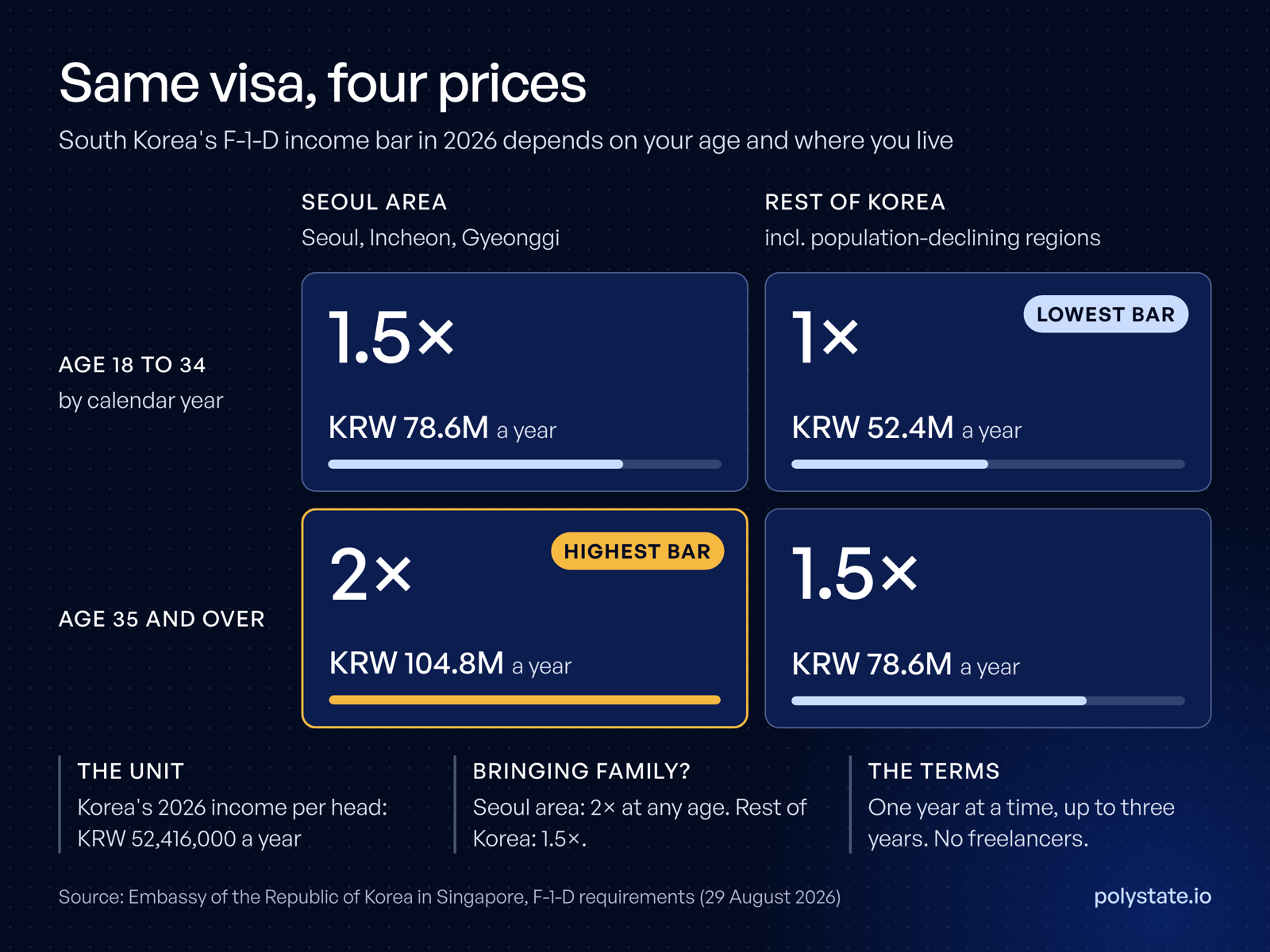
At that point a nomad visa is no longer immigration policy. It is regional development policy that happens to stamp passports.
Containment. Hungary and Malta write the stop-the-clock rule into the visa itself. They want the spending and not the settlers. That is a legitimate choice. It just should not be marketed as a path.
Who gains, who loses
The host state wins most. It collects consumption taxes and rents on foreign income, carries no welfare obligations, adds no voters, and can change the price every January.
The remote worker gains real optionality. Dozens of countries now compete for the same laptop, and exit costs a flight. That is a genuine shift of power from states to mobile individuals, and it is why the category keeps spreading.
What the remote worker gives up is accumulation. Five years on nomad visas in five countries can leave you exactly where you started: no permanent residence anywhere, no passport, and a tax position decided by day counts.
Mobility without compounding.
Locals sit in the middle, and housing is where the backlash shows up. Spain ended its golden visa in April 2025, and the government gave housing affordability as the main reason. Expect nomad visa terms to tighten in the same places, for the same reason.
The best digital nomad visas for 2027, by region
All figures were checked on 26 October 2026.
Europe: slower, and only some of the years count
- Spain: about €2,849 a month, 200% of the 2026 minimum wage. Citizenship after 10 years, or 2 for Ibero-American nationals.
- Portugal (D8): €3,680 a month in 2026, €3,880 from January if the proposed minimum wage passes. Citizenship after 10 years, or 7 for EU and Portuguese-speaking nationals.
- Croatia: €3,622.50 a month, or €43,470 in savings for a 12-month stay. Up to 18 months, then a new application only after six months away.
- Greece: €3,500 a month, per the Greek government's 2021 announcement of the scheme. Seven years to citizenship.
- Cyprus: €3,500 net a month, plus 20% for a spouse and 15% per child.
- Estonia: €4,500 a month over the previous six months (official pages differ on whether that is gross or net). The highest bar in Europe here.
- Italy: about €25,500 a year for self-employed nomads, three times the health-contribution exemption level, per Italian consulates' 2026 checklists. The lowest bar in this European list.
- Malta: €42,000 a year gross. The time does not count toward permanent residence.
- Hungary (White Card): €3,000 net a month for the six months before you arrive. One year plus one, presence only.
Asia and the Gulf: presence only
- Thailand (DTV): THB 500,000 in funds. Valid five years, 180 days per entry, extendable by 180 days. The longest runway on this list.
- Malaysia (DE Rantau): US$24,000 a year for tech workers, US$60,000 for everyone else. Up to two years.
- Taiwan: US$20,000 a year if you are 20 to 29, US$40,000 if 30 or over, for nationals of visa-exempt countries. Six months at a time, up to two years in total.
- Philippines: sufficient income earned outside the Philippines, and only for nationals of countries that offer Filipinos the same visa. One year, renewable once.
- Dubai (Virtual Working Programme): US$3,500 a month and a remote contract with an employer outside the UAE. One year, renewable.
- Indonesia (E33G): US$60,000 a year from an employer outside Indonesia. Up to one year.
- Japan: JPY 10,000,000 a year, for nationals of eligible countries only. Six months, no extension.
- South Korea (F-1-D): from KRW 52.4 million a year under 35 outside the Seoul area, up to twice that over 35 in Seoul. One year at a time, up to three years. Not open to freelancers.
Latin America: lowest bars, shortest roads
- Uruguay: no fixed income bar. You sign a sworn statement that you can support yourself. Six months plus six, then you can switch to temporary or permanent residence. Citizenship after 3 years with family, 5 without.
- Colombia: three times the minimum salary, about COP 5.25 million a month in 2026.
- Brazil: US$1,500 a month from a foreign employer, or US$18,000 in the bank. Up to one year, renewable.
Compare every program side by side on our digital nomad visa page.
The case for nomad visas anyway
"It is the cheapest way to test a country." True, and the best use of the category. Six months in Lisbon or Bangkok tells you more than any spreadsheet. Just do not confuse a trial with a plan. The clock that matters starts on a residence permit, not a nomad stamp.
"Immigration status is a detail. Tax residence is what matters." Half right. A nomad visa can make you tax resident without moving you an inch toward membership, which is the worst combination available: taxed like a resident, treated like a guest. Some states design around this. Korea, for example, taxes short-term foreign residents on foreign income only when it is paid in or remitted to Korea. Most do not, so the 183-day rule still decides your bill.
"Some nomad visas do lead somewhere." Yes, and those are the ones to pick if residence is the goal. Uruguay lets you move from the nomad permit into residence, with citizenship after 3 to 5 years. Which is the whole point of the model: buy the layer you actually want.
A disclosure, since we are asking you to read the fine print. Polystate sells residency services, so we have a stake in telling you that residence beats presence. Weigh that. Then check the numbers above, which are linked to the governments that set them.
What to do with this
- If you want presence: pick on the bar and the runway. Uruguay, Colombia and Brazil ask the least. Thailand's DTV runs the longest.
- If you want residence: pick a visa that converts, or skip the nomad category entirely. Paraguay's temporary residency needs no investment and leads to permanent residence in two years.
- If you want membership: read the citizenship clock, not the visa. Portugal is now 10 years for most nationalities, Spain 10, or 2 for Ibero-Americans.
- If you are moving a family: check the family rules before the income bar. Hungary offers no family visas, Korea raises the bar to 1.5 or 2 times income per head when a spouse or children come, and Cyprus adds 20% for a spouse and 15% per child.
- If you freelance: read the eligibility line first. Many of these visas are built for employees and company owners. Korea excludes freelancers outright, and Hungary wants a foreign employer or a profitable foreign company.
The open edge
Estonia already sells the two halves separately. Its nomad visa sells presence with no identity. Its e-Residency, running since December 2014, sells a digital identity with no citizenship, no residence and no change to your tax residency.
Nobody yet sells the bundle a mobile person actually wants: presence in many places, residence in one, membership that travels with you. That is the gap pop-up cities and network states keep running into. Community first, land later works for building a society. It does not yet produce a permit.
The open question for 2027 is whether any state decides to compete on the whole bundle. Or whether the year and a day stays dead.
Figures checked against official sources where available on 26 October 2026. We update this page when the 2027 figures are published.
This analysis is general information, not legal or tax advice. Visa rules and income thresholds change, and cross-border tax outcomes are fact-sensitive. Confirm current requirements with the issuing authority, and consult a qualified advisor before making residency decisions.
Evaluating your jurisdictional setup? Run the Polystate diagnostic to compare options, or explore our services.