
Citizenship by Investment 2027: Who Really Sets the Price
Citizenship by investment in 2027: every programme priced from official sources, and why Brussels and Washington now set the value of what you buy.
The short answer: citizenship by investment in 2027 still starts in the Caribbean, at the US$200,000 Dominica asks from a single applicant. Argentina is the big new entry at US$350,000. Below US$200,000 you can still buy a passport, but not one that gets you into Schengen without a visa. Every programme, with prices checked against official sources on 26 October 2026, is further down.
The price is the easy part. The hard part is that the country selling you the passport no longer decides what it is worth.
On 1 January 2026, the United States partially suspended visas for nationals of Antigua and Barbuda and Dominica. Immigrant visas, plus tourist, business, student and exchange visas. The stated reason was citizenship sold without residence. Nobody in Roseau or St John's voted on that. Nobody who had bought a passport there was asked.
A Caribbean passport is a derivative. The underlying is the visa policy of Brussels, Washington and London.
Price it like one.
"With a great sum obtained I this freedom"
Selling citizenship is not new. In the Book of Acts, a Roman tribune tells Paul that he bought his citizenship for a large sum. Paul answers that he was born a citizen. The exchange is two thousand years old and already contains the whole market: the bought status works, and the born status still carries more weight.
The modern version starts in 1984, when St Kitts and Nevis opened the oldest programme still running. Dominica followed in 1993. For most of the next forty years the model was simple. A small island state sold membership, and the passport's real value came from access granted by larger states that were not paying attention.
They are paying attention now.
Issuer, gatekeepers, clock
Every investment passport involves three parties, and buyers usually only look at the first:
- The issuer: the state that sells you citizenship. It sets the price, the due diligence and the paperwork.
- The gatekeepers: the EU, the US, the UK and others whose visa decisions decide where that passport actually takes you. They set the value, and they can change it without telling the issuer first.
- The clock: what the passport asks of you in time. For forty years the Caribbean asked nothing. That is changing.
Read the 2027 news through these three lines and it sorts itself out. Argentina is a new issuer. ECCIRA's 30-day rule is a new clock. Everything else is gatekeepers moving.
The 2027 squeeze: gatekeepers move first
The EU wrote the rule. Since 30 December 2025, Regulation (EU) 2025/2441 makes investor citizenship schemes a ground for suspending visa-free travel. The precedent already exists. Vanuatu's visa-free access to Schengen was suspended in February 2023 and revoked in December 2024, with its passport sales given as the reason.
Brussels is using it. In a letter of 25 June 2026, reported in the press but not published by the EU, the European Commission asked Antigua and Barbuda to phase out its programme by June 2028. The Commission's next report on visa-free countries is due in December 2026.
Washington went further, faster. Proclamation 10998 suspended immigrant visas and B, F, M and J visas for nationals of Antigua and Barbuda and Dominica from 1 January 2026. It is reviewed every 180 days.
London moved back in 2023. The UK put Dominica and Vanuatu on its visa list in July 2023 and cited their citizenship sales.
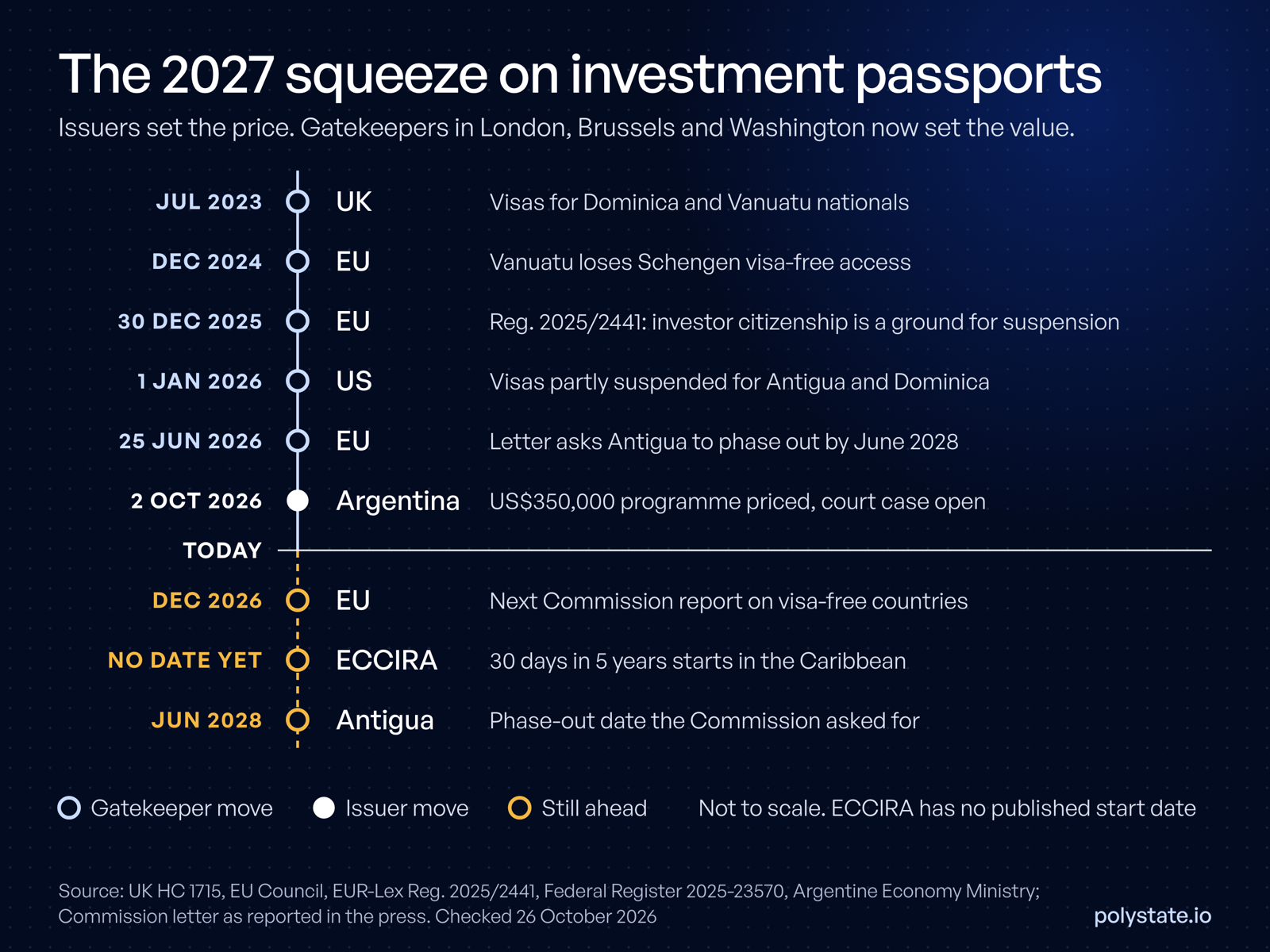
The clock arrives. All five Eastern Caribbean states have enacted the ECCIRA agreement, which creates a regional regulator and asks for 30 days in the country, in total, during the first five years. As of 16 October 2026 it was not operational and no start dates had been published. In June we wrote that zero-presence citizenship would end for new applicants on 30 June 2026. That date did not hold, and we have corrected that piece. Antigua's own law asks for 5 days in 5 years, and a bill to raise it to 30 was tabled on 14 July 2026, as reported by IMI Daily.
And a new issuer walks in. On 2 October 2026, Argentina's Economy Ministry put a price on citizenship: a non-refundable US$350,000 or a US$800,000 government bond, with applications due in the fourth quarter. The decree behind it was annulled by the electoral court on 30 June 2026, and the government's appeal is pending. We covered the details in our Argentina breakdown.
Who gains, who loses
The gatekeepers gain the most leverage, at almost no cost. A visa waiver is cheap to grant and cheap to threaten. For a small state that earns a large share of its budget from passport sales, the threat is existential. For the EU it is a line in a report.
The issuers lose pricing power on the one thing they cannot control. They can raise due diligence, add a stay rule and harmonise a US$200,000 floor across the region, and they have done all three. They cannot promise a buyer that Schengen access will still be there in 2028.
Born citizens lose too, and nobody priced that in. The US suspension of student and exchange visas applies to every national of Dominica and Antigua, not only to those who bought in. A teenager in Roseau applying to a US university pays for a programme they never used. That is the political cost that will eventually decide these programmes, more than any letter from Brussels.
Argentina gains from the contrast. A country of 46 million cannot be pressured the way a small island state can, and its passport is held mostly by people who were born with it. The gatekeepers have less reason to target it. Its risk sits at home, in a court case and an election in October 2027, not abroad.
The buyer gains one thing from all this: clarity. The cheap programmes without Schengen access, and the programmes under active pressure, are now labelled.
Citizenship by investment programmes for 2027, cheapest first
Prices are the published minimum, checked on 26 October 2026. Some programmes price a single applicant, others a family of up to four, and we say which.
- Nauru: a US$25,000 discount off the contribution for applications filed before 31 December 2026, per the programme office. IMI Daily reports a base contribution of US$115,000, so about US$90,000 with the discount. Decisions in three to four months, no minimum stay. No visa-free access to Schengen.
- Vanuatu: US$130,000 for a single applicant, per the citizenship office. Schengen visa-free access revoked in December 2024.
- Dominica: US$200,000 for a single applicant, US$250,000 for a family of four. Due diligence US$7,500 for the main applicant and US$4,000 per dependant aged 16 or over. About three to six months. Schengen visa-free, but a UK visa since 2023 and US visas restricted since January 2026.
- Antigua and Barbuda: US$230,000 for a family of up to four, plus US$20,000 in processing fees. Under EU pressure to phase out by June 2028, and US visas restricted since January 2026.
- Grenada: US$235,000 for a main applicant with up to three dependants, set by the 2024 amendment regulations (S.R.O. 12 of 2024). The only Caribbean country with a US E-2 investor treaty. The government has said it will replace the 2013 Act with a new law, according to NOW Grenada.
- St Lucia: US$240,000 for an applicant with up to three dependants.
- St Kitts and Nevis: US$250,000 for a main applicant or a family of up to four, plus fees of US$10,000 for the main applicant and US$7,500 per dependant aged 16 or over.
- Argentina: US$350,000 non-refundable or an US$800,000 bond for the main applicant. US$100,000 for a spouse or an unmarried child aged 18 to 25, US$25,000 per child under 18. Applications from Q4 2026, subject to the court case.
- Turkey: from US$400,000 in property that cannot be resold for three years. Turkish citizens need a visa for Schengen. Turkey has an E-2 treaty with the US.
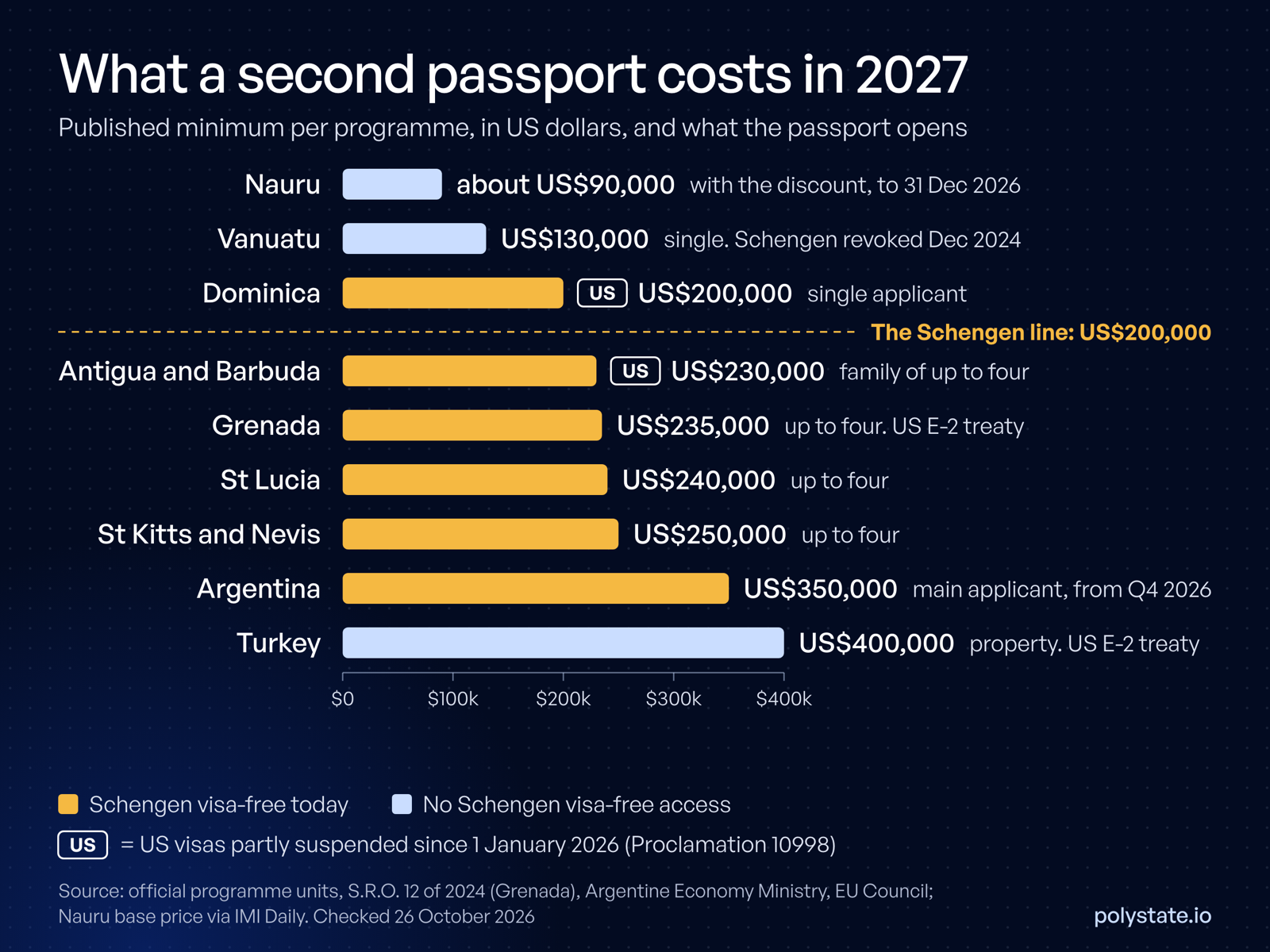
The ladder has a clear break. Everything under US$200,000 is cheap because a gatekeeper has already said no to it.
The case for buying anyway
"The EU went after Vanuatu, a Pacific outlier. It will not cut off five Caribbean states." Possibly. Vanuatu sold passports at a lower price, far from Europe's diplomatic interests. But the 2025 regulation now names investor citizenship as a ground in itself, and the Commission has put a date on Antigua. A buyer does not need the worst case to happen. The passport is worth less the moment the threat is credible, because every buyer after you prices it in.
"Thirty days in five years is nothing." True as a cost. Six weeks of holiday across five years is not hard. What changes is the product. A passport with a presence rule is a small step toward naturalisation, and once the principle exists it can be raised. Antigua's bill shows how a number moves from 5 to 30.
"Argentina is a real country, so it must be safer." Safer from Brussels, yes. Riskier at home. The decree is before the Supreme Court, the contribution does not come back, and fees, bond terms and processing times were not published when we checked. Real country, unfinished product.
"Any passport is a hedge. Who cares about the details?" If the goal is a document to leave with in a crisis, the cheap end works. Just do not pay Caribbean prices for that, and do not pay any price for access the passport no longer has.
A disclosure. Polystate sells residency services, and we think residence often beats a bought passport, so we have a stake in this argument. Weigh that, then check the linked figures above against the governments that set them.
What to do with this
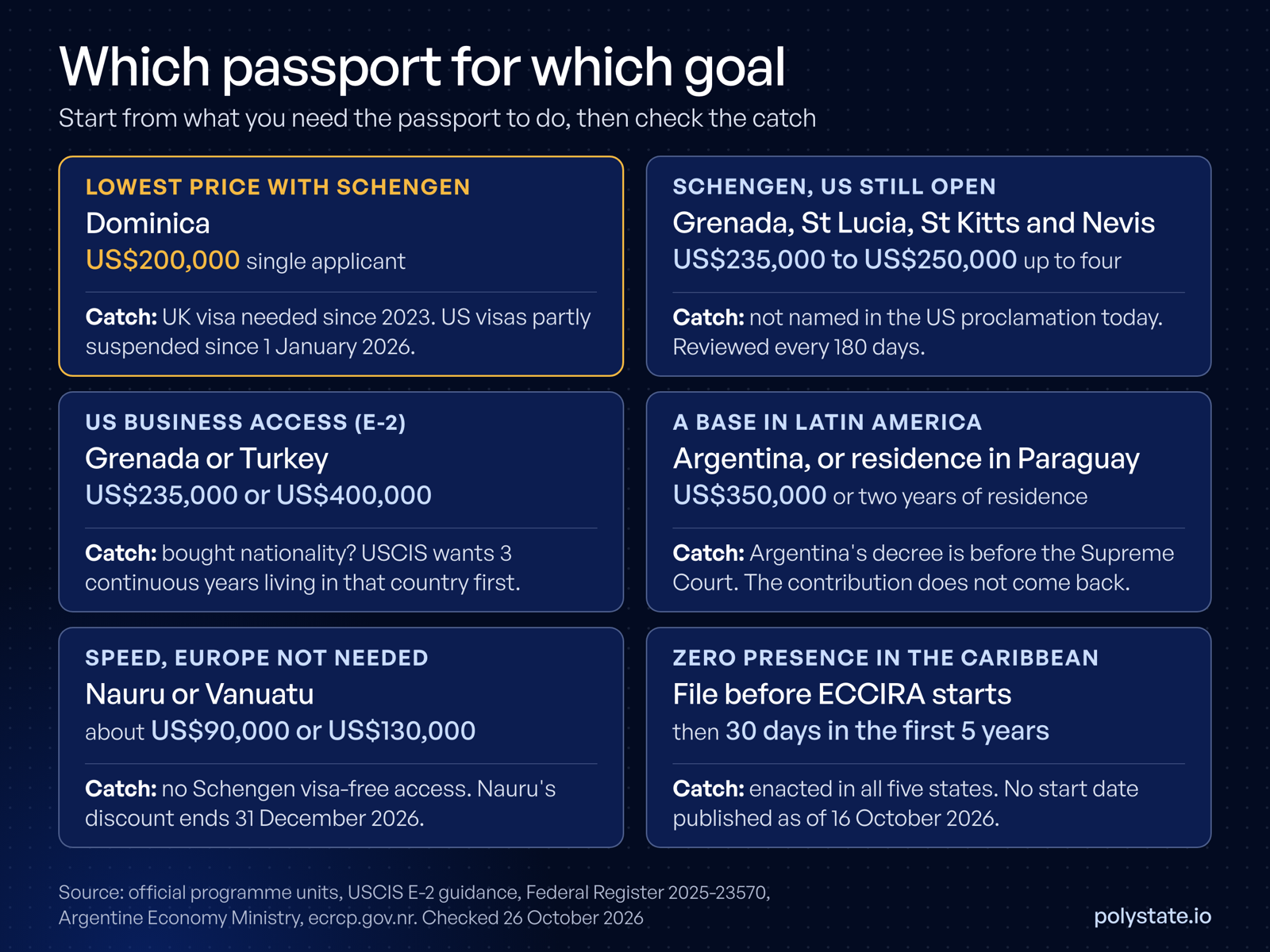
- If you want the lowest price with Schengen access today: Dominica at US$200,000 for a single applicant. Accept that US visas are restricted and that UK visits need a visa.
- If you need the US to stay open: Grenada, St Lucia or St Kitts and Nevis, none of which is named in the US proclamation. Check the 180-day review before you file.
- If you want US business access through the E-2: Grenada or Turkey, with a catch. Under USCIS rules, if the nationality came through investment you must have been domiciled in that country for three continuous years before you can apply.
- If you want a base in Latin America: weigh Argentina's US$350,000 against two years of real residence. Paraguay's residence route costs a small fraction of that, and Argentina's ordinary route is two years.
- If you want speed and do not need Europe: Nauru before the discount ends on 31 December 2026, or Vanuatu. Be clear on what you are buying.
- If you are about to file in the Caribbean: file before ECCIRA's 30-day rule starts. No start date was published as of 16 October 2026.
- Before paying for anything: look up what the passport opens today on our Passport Power Index, not what the brochure printed last year.
The open edge
The Caribbean is adding a stay rule. Argentina's ordinary route asks for two years of residence. Portugal asks ten. The line between buying citizenship and earning it is moving, from both sides, toward the middle.
The gatekeepers drew it. The EU's regulation targets citizenship granted without a genuine link to the country. Thirty days in five years is the Caribbean's first attempt to show such a link. Whether Brussels accepts 30 days as genuine, or decides it means a year, is the most important number in this market, and nobody has published it yet.
We will update this page when the EU's December 2026 report lands.
Figures checked against official sources where available on 26 October 2026. Nauru's base price and Antigua's 30-day bill are cited from press reports and named in the text.
This analysis is general information, not legal or tax advice. Programme rules, visa access and fees change, and cross-border outcomes are fact-sensitive. Confirm current terms with the programme's official unit, and consult qualified immigration and tax advisors before you pay.
Evaluating your jurisdictional setup? Run the Polystate diagnostic to compare options, or explore our services.