
Best Golden Visas 2027: Where the Money Has to Go
The best golden visas for 2027, priced from official sources, and the shift most lists miss: states now decide where your money goes, and homes are out.
The short answer: the best golden visas for 2027 are Hungary and Greece for the lowest entry into the EU, Cyprus and Malta if you want permanent residence from day one, and the UAE if you want a tax base rather than a passport. In the Americas, Panama, Costa Rica and Paraguay cost less and ask less. Every price below was checked against official sources on 26 October 2026, and the full list is further down.
First, a pattern. In September, Latvia stopped granting residence permits to people who buy property. Spain closed its whole programme in April 2025. Portugal stopped counting real estate in October 2023. Three countries, three years, one direction.
Golden visas are not dying. They are moving out of housing.
The 2027 question is no longer only "how much". It is "where does the state make you put the money, and do you ever get it back". Homes are the asset class governments now least want to sell to foreigners. Funds, startups, deposits and flat contributions are what they want instead.
You are not buying a house with a permit attached. You are parking capital where a ministry tells you to. Price it that way.
A product born in a housing crash
The modern golden visa is a child of 2008. Latvia opened its scheme in 2010. Ireland and Portugal followed in 2012, Spain and Greece in 2013. The timing was not an accident. Southern and Eastern Europe were sitting on unsold apartments and broken bank balance sheets, and a foreign buyer with half a million euros was the cleanest fix on offer. No new debt, no bailout conditions. A stamp in exchange for a deed.
It worked. Then it worked too well.
The apartments got sold, prices recovered, and the same housing that had been a problem of oversupply became a problem of affordability. When Spain ended its golden visa, the government gave housing as the main reason. A programme born to clear a glut died as a cause of scarcity.
That reversal is the key to reading every price on this page.
Collateral, permit, clock
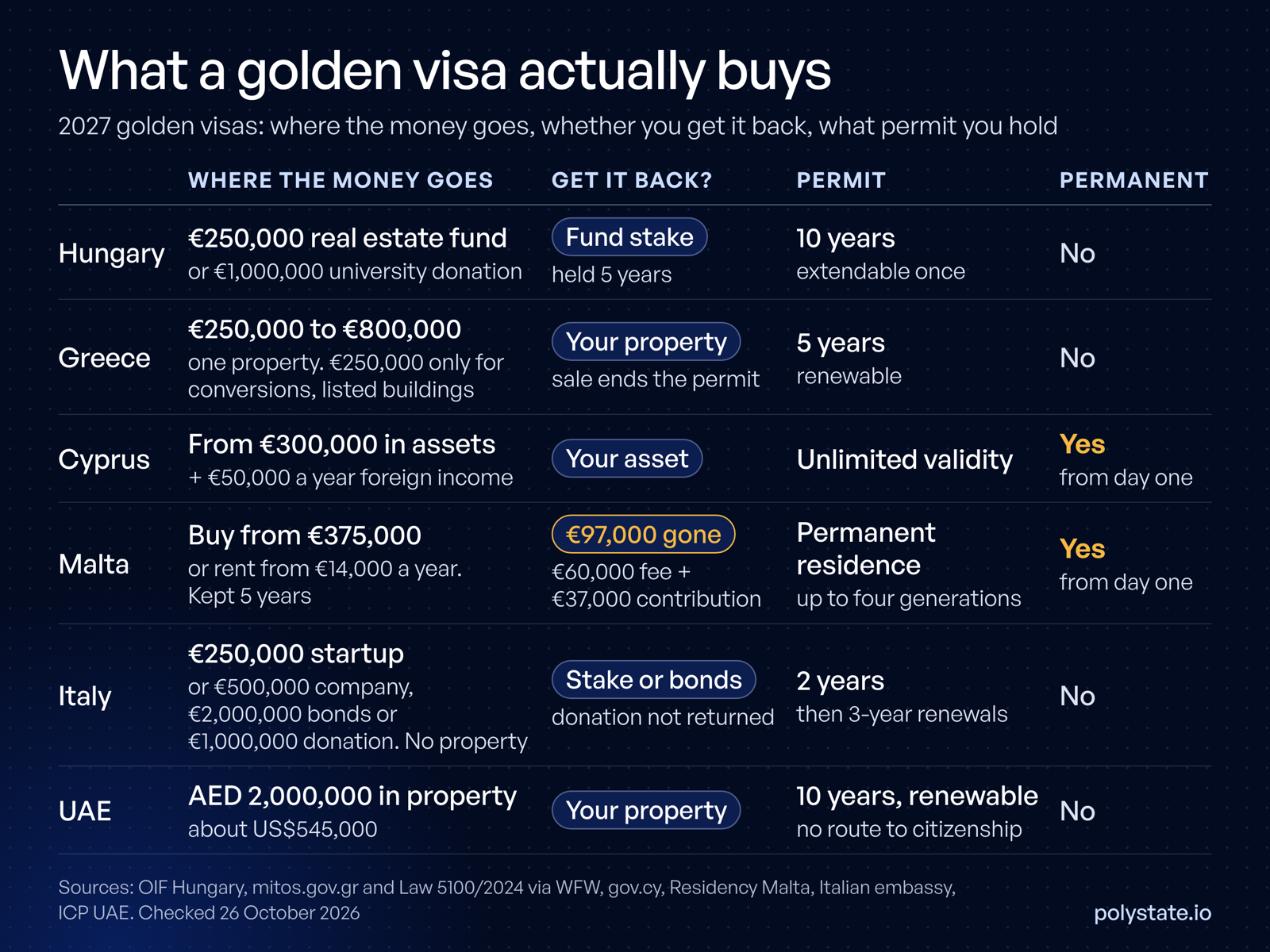
Every golden visa is three separate deals, sold as one:
- Collateral: what you must put up, where it has to sit, for how long, and whether you get it back. A property you can resell, a fund stake you can redeem, or a contribution that is gone on day one.
- Permit: what the money buys. A temporary permit you must renew, or permanent residence that does not expire.
- Clock: whether the years count toward anything. Naturalisation almost everywhere needs real residence, and most golden visas carry no minimum stay. A permit you never use is a clock that never starts.
Read the brochures through these three lines and the rankings change. Hungary's €250,000 goes into a fund you can exit after five years. Malta's programme asks for a €60,000 administration fee and a €37,000 contribution that you will never see again, on top of the property. Both are "golden visas". One is collateral. The other is mostly a price.
The clock is where most buyers get hurt. Portugal is the clearest case. Its golden visa still exists through funds and other non-property routes, but Lei Orgânica 1/2026 moved citizenship from 5 years to 10 (7 for EU and Portuguese-speaking nationals) from 19 May 2026. We called it the ratchet in June: the permit survived, the fast passport behind it did not. Anyone who bought in 2023 for a five-year passport now holds the same collateral and half the clock.
Where the money has to go now
Put the 2023 to 2026 changes side by side and one movement shows up.
Housing is being pushed out. Portugal removed real estate in October 2023. Spain closed in April 2025. Latvia's new Immigration Law, in force since 15 September 2026, ended permits for property buyers and for investors in bank subordinated liabilities. A week later the Latvian government endorsed a plan to close investor permits entirely. Not final yet, but the direction is not in doubt.
Where housing stays, it gets steered. Greece kept property but split it. Under Law 5100/2024, as summarised by the law firm Watson Farley & Williams, the bar is €800,000 in Attica, Thessaloniki, Mykonos, Santorini and islands with more than 3,100 residents, and €400,000 elsewhere, in a single property of at least 120 m², with short-term rentals through platforms like Airbnb barred. The €250,000 route survives only for converting non-residential buildings into homes or restoring listed buildings, both on the national register of procedures. Read that as housing policy: the cheap ticket is reserved for people who add a home to the stock, not take one out of it.
Everything else drifts toward finance. Hungary sends the money into a real estate fund registered with the central bank. Italy never had a property route at all. Panama's new decree added a US$500,000 fixed-term deposit at a state bank. Malta layers a large non-refundable contribution over the property.
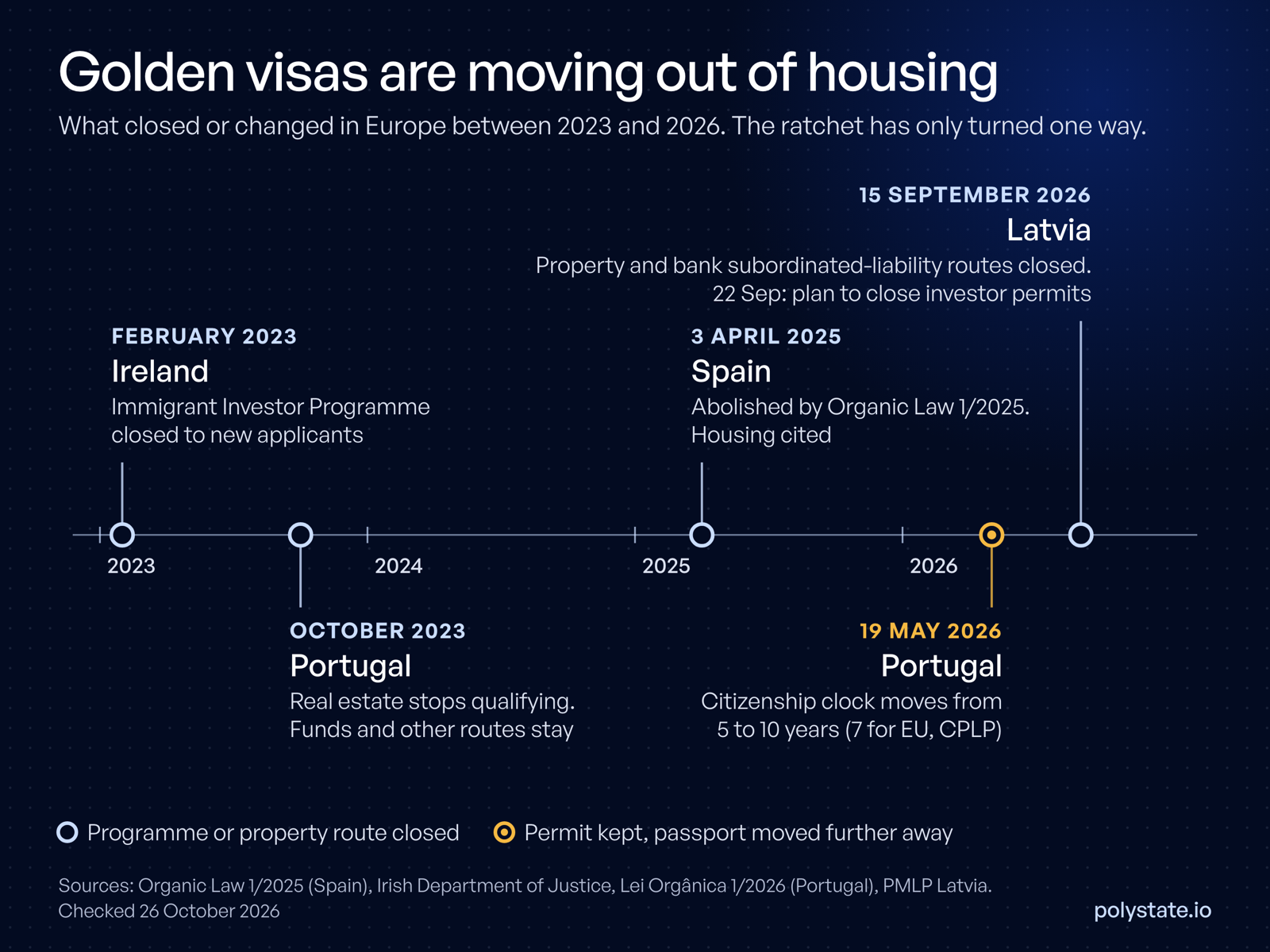
From bricks to balance sheets. The state still wants your capital. It just wants it somewhere voters cannot see it in the rent.
Who gains, who loses
The host state gains most, and it gains more with every change. A property purchase helps the seller and the notary. A fund stake, a bond or a contribution goes where the government points it. Malta's €97,000 in fees and contributions per application is revenue no housing minister has to defend.
Fund managers gain a captive client. When the law says "a fund registered with the central bank, held five years", the fund does not have to compete very hard for your money.
Locals gain, at least on paper. Every closed property route is a political answer to rent. Whether it moves prices is another question, but the signal is cheap to send.
The buyer loses two things. Liquidity, because collateral is now locked for five years in Hungary and Malta and tied to the permit in Greece. And the clock, because the programmes that still sell residence are increasingly the ones that do not lead quickly to a passport. Residence without membership. A long lease on a door that may not open.
The Gulf gains by not playing the same game. The UAE asks for AED 2,000,000 in property, gives a renewable 10-year residence, and offers no route to citizenship at all. It never pretended to sell membership, so it has nothing to take back.
The best golden visas for 2027, by region
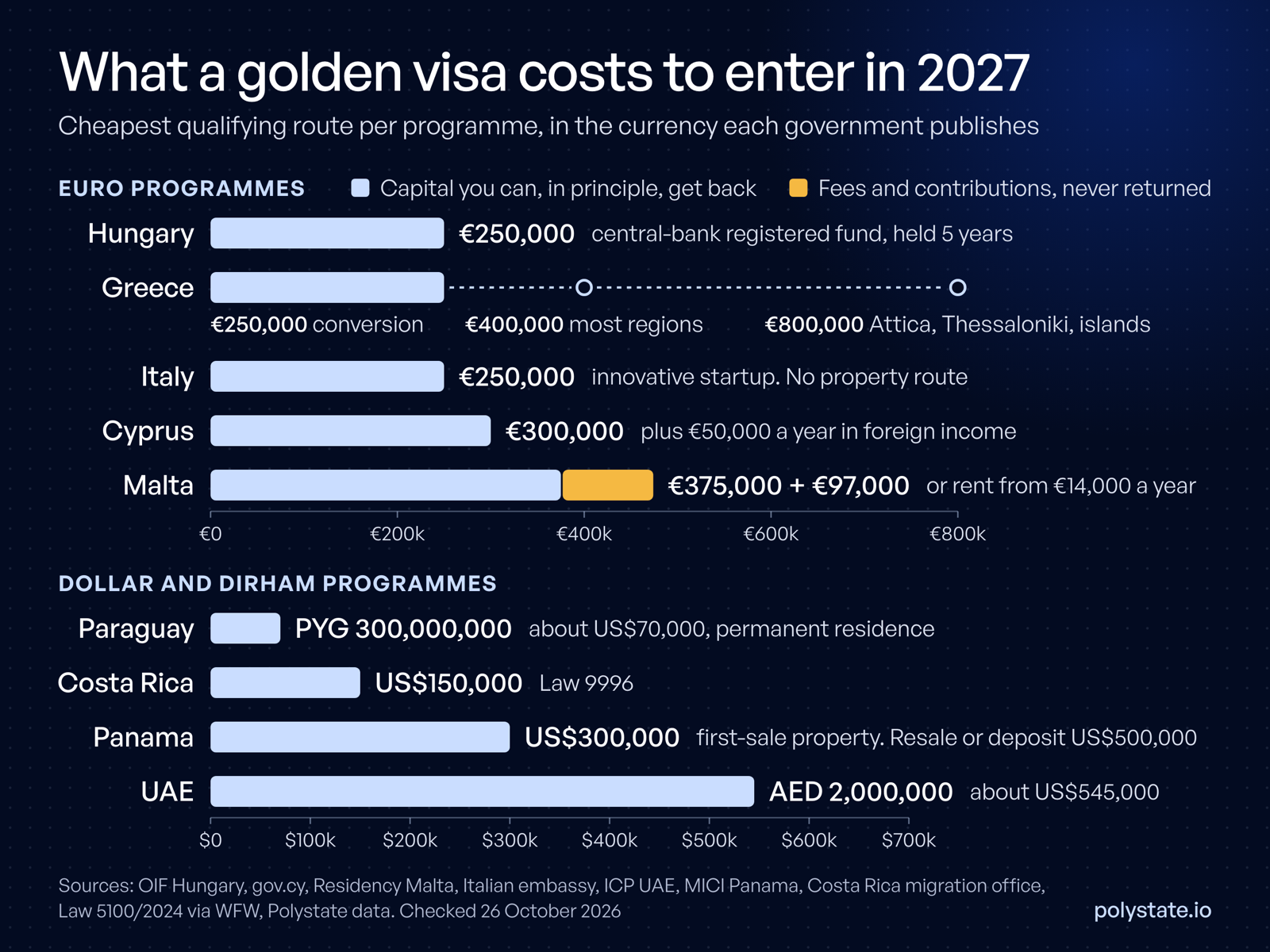
Prices are the cheapest qualifying route, checked on 26 October 2026, and exclude legal fees unless stated. Currencies are as the government publishes them.
Inside the EU
- Hungary (Guest Investor Residence Permit): €250,000 into a real estate fund registered with the Hungarian central bank and held for five years, or €1,000,000 donated to a Hungarian university. A 10-year permit, extendable once. No minimum stay.
- Greece: €250,000 for converting a non-residential building to a home or restoring a listed building. Otherwise €400,000, or €800,000 in Attica, Thessaloniki, Mykonos, Santorini and the larger islands, per the Watson Farley & Williams summary of Law 5100/2024. Five-year renewable permit, no minimum stay. Selling the property ends the permit.
- Cyprus (permanent residence): from €300,000 in qualifying assets, plus a secure foreign income of €50,000 a year, €15,000 more for a spouse and €10,000 per child. Permanent residence with unlimited validity.
- Malta (Permanent Residence Programme): rent from €14,000 a year or buy from €375,000, kept for five years, plus a €60,000 administration fee and a €37,000 contribution. €7,500 for each adult dependant other than a spouse. Up to four generations can go on one application.
- Italy (Investor Visa): €250,000 into an innovative startup, €500,000 into an Italian company, a €1,000,000 philanthropic donation, or €2,000,000 in government bonds, per the Italian embassy's programme summary. No property route. A two-year permit, renewed for three years at a time while you keep the investment.
- Portugal: still open through funds and other non-property routes, now on a 10-year citizenship clock.
The Gulf
- UAE (Golden Residence): AED 2,000,000 in property, about US$545,000 at the dirham's dollar peg. A 10-year renewable residence. No personal income tax, and no route to citizenship.
The Americas
- Panama (Qualified Investor): Executive Decree 17 of 8 September 2026 keeps US$300,000 for first-sale property, sets US$500,000 for resale property, and adds a US$500,000 fixed-term deposit at Banco Nacional or Caja de Ahorros.
- Costa Rica: investor residence from US$150,000 under Law 9996, according to the migration office. The law's tax breaks for new investors applied only to its first five years, which ran to about July 2026.
- Paraguay: permanent residence through the SUACE investor route at PYG 300,000,000, about US$70,000. Or no investment at all: temporary residency needs none and leads to permanent residence after two years.
Closed or changed
- Spain: abolished from 3 April 2025 by Organic Law 1/2025.
- Ireland: the Immigrant Investor Programme closed to new applicants on 15 February 2023.
- Portugal (property): real estate stopped qualifying in October 2023.
- Latvia: no permits for property buyers or bank subordinated-liability investors since 15 September 2026, and a government plan to close investor permits altogether.
Compare these side by side on our residency programmes page.
The case against reading it this way
"Property is still the best collateral. It holds value and you can live in it." Sometimes. But the permit now dictates the property: one unit, a minimum size, no short-term letting in Greece, five years of holding in Malta, and in Greece the permit ends the day you sell. That is an asset with a covenant on it. Price the covenant, not just the square metres.
"A fund stake is riskier than a flat." It can be. A fund registered with a central bank still invests in real estate and still has to sell it to pay you out. The honest comparison is not flat versus fund. It is "asset I choose" versus "asset the state chose for me", and the second one has fewer exits.
"Permanent residence beats a passport anyway." For travel and a tax base, often yes. Cyprus and Malta give permanent residence on day one, and the UAE gives ten renewable years with no income tax. If you do not need a vote or an EU passport, this is the best value on the list. If you do, no golden visa on this page gets you there quickly anymore. That is a different market, covered in our citizenship by investment guide for 2027.
A disclosure, since we are asking you to read the fine print. Polystate sells residency services, so we have a stake in telling you that residence is worth buying. Weigh that. Then check the figures above, which are linked to the governments that set them.
What to do with this
- If you want the cheapest EU permit with capital you can recover: Hungary's €250,000 fund route or Greece's €250,000 conversion route. Read the five-year lock in Hungary and the sale clause in Greece before you wire.
- If you want permanent residence for a family now: Cyprus, if you can show €50,000 a year in foreign income, or Malta, if you can absorb about €97,000 in fees and contributions that do not come back.
- If you want a tax base, not a passport: the UAE. Ten years, renewable, no personal income tax.
- If you want the Americas at the lowest cost: Paraguay's residence route, then Costa Rica at US$150,000 or Panama at US$300,000.
- If you want a passport: do not buy a golden visa for it. Portugal now takes 10 years. Look at citizenship programmes directly, or at naturalisation where the clock is short and you would actually live.
- If you are moving soon: buy on today's terms. Latvia shows how fast a route can disappear.
The open edge
Malta already charges about €97,000 that you never get back, and Argentina is now selling citizenship for a straight US$350,000 contribution with no asset at all. The collateral is thinning toward zero.
When it reaches zero, the golden visa stops pretending to be an investment. It becomes what it always partly was: a subscription to a jurisdiction, priced by the state, renewable at the state's discretion.
The open question for 2027 is whether buyers will pay subscription prices for residence that does not convert into membership. Or whether the market splits for good, with cheap permanent residence on one side, expensive passports on the other, and nothing in between.
Figures checked against official sources where available on 26 October 2026. Greece's tiers are cited from a law firm's summary of Law 5100/2024 because the national register does not yet list them. We update this page when the 2027 figures are published.
This analysis is general information, not legal or tax advice. Programme rules and thresholds change, and cross-border tax outcomes are fact-sensitive. Confirm current requirements with the issuing authority, and consult a qualified advisor before making residency decisions.
Evaluating your jurisdictional setup? Run the Polystate diagnostic to compare options, or explore our services.